
(English)
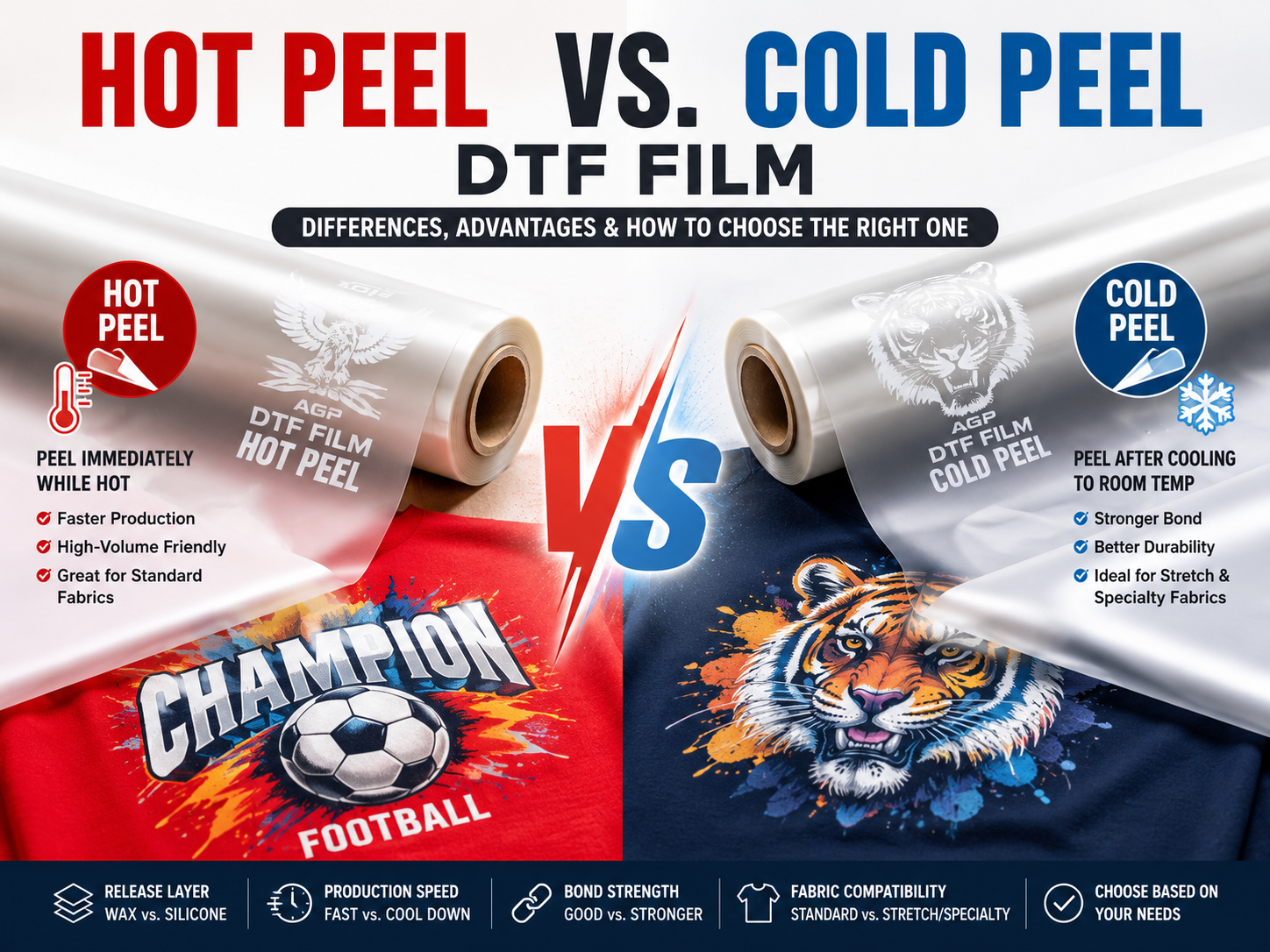
Quick answer: Hot peel DTF film uses a wax-based release layer that lets you peel the transfer immediately while it's still hot — faster for high-volume production. Cold peel film uses a silicone-based release layer that needs to cool to room temperature before peeling, which takes longer per piece but is widely regarded as giving a stronger bond, especially on stretch fabrics and specialty materials like canvas or flannel. Neither is universally "better" — the right choice depends on your production speed needs and the fabric you're printing on.
Both film types go through the exact same DTF printing workflow — the ink is printed onto the film, hot-melt powder is applied and cured, and the transfer is pressed onto the garment. The difference only shows up at the very last step: how and when you remove the carrier film.
The reason comes down to the release layer coating on the film. Hot peel film uses a wax-based release layer, which lets the film separate from the transfer immediately, while it's still hot off the press. Cold peel film uses a silicone-based release layer, which needs to cool to room temperature before it will release cleanly — pull it off too early and you risk lifting part of the design with the film.
| Factor | Hot Peel | Cold Peel |
|---|---|---|
| Release layer material | Wax-based | Silicone-based |
| When to peel | Immediately, while still hot | After cooling to room temperature |
| Production speed | Faster — no wait between pieces | Slower — cooling step adds time per piece |
| Bond strength / durability | Good when pressed correctly; less margin for error | Generally regarded as stronger, more consistent bond |
| Best fabric fit | Standard cotton/poly blends, large simple graphics | Stretch fabrics, canvas, flannel, specialty materials |
| Beginner-friendliness | Requires timing precision — peel too slow and it can overbond, peel wrong and edges lift | More forgiving — the wait removes the timing pressure |
Note: press temperature and timing figures vary noticeably across manufacturers — published ranges span roughly 140-170°C (285-340°F) and 5-20 seconds depending on the specific film and press. Always start from your film's technical data sheet rather than a generic number, and run a test piece before a full production batch.
This is one area where you'll find conflicting information across the industry, so it's worth being upfront about it rather than repeating a confident claim that doesn't hold up. Some sources describe hot peel as producing a smoother, matte finish; others describe hot peel as glossier, with cold peel offering either matte or glossy depending on the specific product line.
The practical takeaway: finish (matte vs. glossy) is a property of the specific film formulation, not a universal rule tied to peel type. If finish matters for your order — say, a client wants a matte, soft-hand result — check the technical data sheet for the exact film you're using, or request a sample, rather than assuming based on "hot peel" or "cold peel" alone.
Most established shops don't pick one exclusively — they stock both and choose per order. If you're running a DTF-A30 for smaller runs or a higher-volume 60cm setup, either film type will run through the same printer and workflow without any equipment changes — the decision happens at the film-ordering stage, not the printing stage.
Not sure which film fits your fabric and production speed? Talk to our team — we supply both hot peel and cold peel PET film alongside our DTF printer lineup.
Contact TODOjet WhatsApp me


