
(English)
Quick Answer: Starting a DTF (Direct-to-Film) printing business in 2026 costs roughly $2,000–$4,500 for a home/side-hustle setup (printer, powder shaker, heat press, initial consumables), $6,500–$12,000 for a small studio setup capable of batch production, and $16,000–$32,000+ for a commercial-scale operation. Most beginners recover their equipment cost within 3–6 months once orders stabilize, depending on order volume and average price per item.
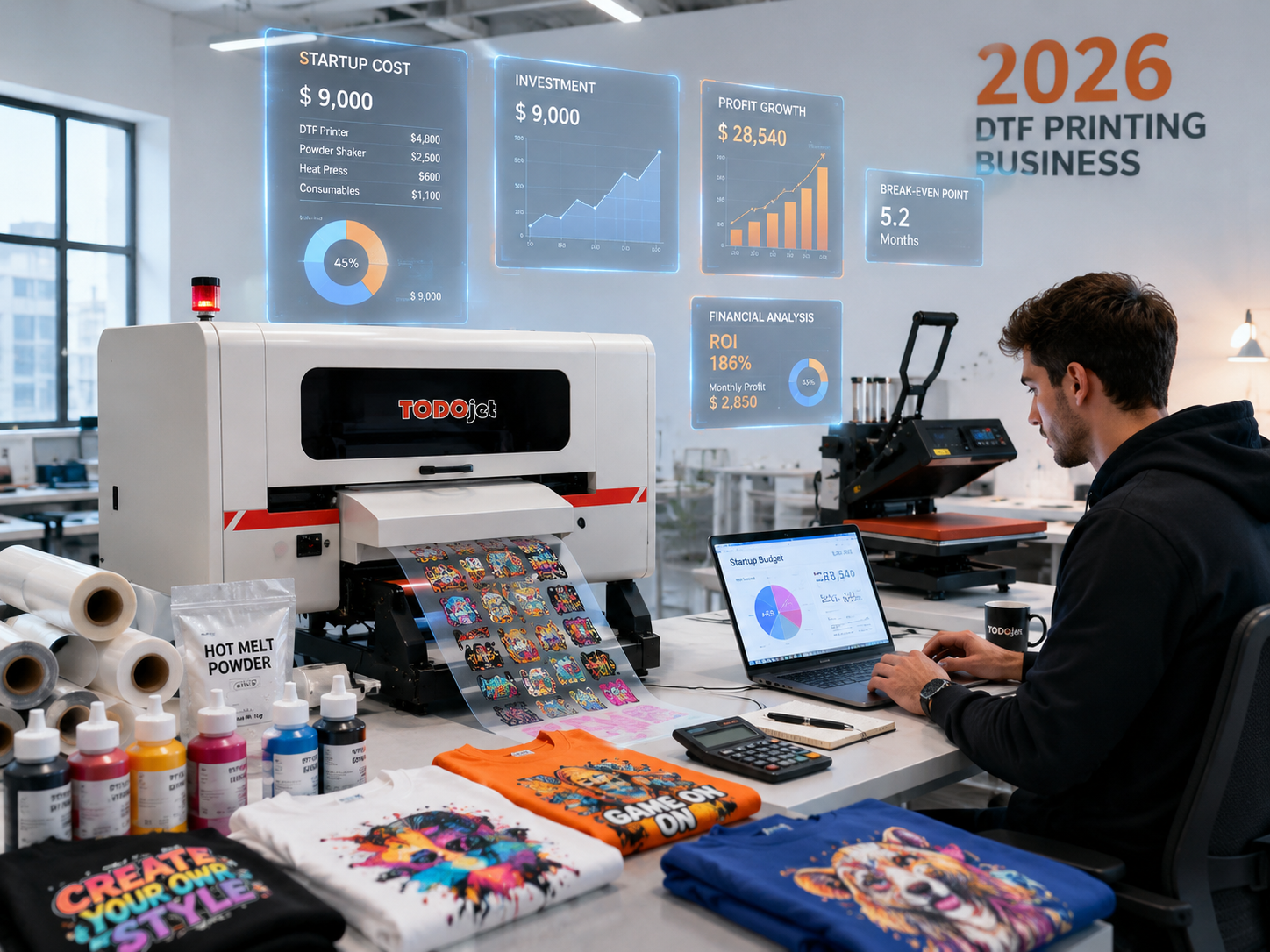
DTF (Direct-to-Film) printing has moved from "emerging technology" to the mainstream production method for custom apparel. Compared to screen printing and DTG (direct-to-garment), DTF offers lower minimum order quantities, works on almost any fabric — cotton, polyester, blends, even nylon — and doesn't require screens or pretreatment.
The question most people get stuck on before jumping in is simple: how much does it actually cost to start? This guide breaks the numbers down line by line so you can budget with confidence before you buy.
Best for: Etsy sellers, TikTok Shop creators, or anyone testing the market before scaling.
| Item | Estimated Cost (USD) | Notes |
|---|---|---|
| DTF printer (A3 size) | $850–$1,700 | Dual Epson printheads are the industry standard at this tier |
| Powder shaker / curing unit (compact) | $280–$550 | Manual or semi-automatic |
| Heat press (home model) | $70–$210 | ~15x15 inch platen |
| Initial consumables (ink, PET film, hot-melt powder) | $210–$420 | Enough for roughly 500–800 finished pieces |
| RIP software license | $0–$280 | Some machines include it; others require a separate license |
| Total | ~$2,000–$3,200 |
Best for: Sellers with steady demand who are ready to handle batch orders.
| Item | Estimated Cost (USD) | Notes |
|---|---|---|
| DTF printer (60cm width, industrial printheads) | $3,500–$6,300 | Mid-range industrial models |
| Automatic powder shaker + curing unit | $2,100–$3,500 | Significantly improves output consistency |
| Industrial heat press | $420–$850 | Supports continuous operation |
| Initial + backup consumables | $700–$1,100 | Enough for 3,000–5,000 pieces |
| Total | ~$6,700–$11,700 |
Best for: Businesses supplying factories, brands, or handling bulk fulfillment.
| Item | Estimated Cost (USD) | Notes |
|---|---|---|
| Industrial DTF printer (multi-head / high-speed) | $11,000–$21,000+ | Wide-format, continuous high-volume operation |
| Automated production line (powder + curing + roll take-up) | $4,200–$8,400 | Reduces manual labor |
| Heat press / curing support equipment | $1,400–$2,800 | |
| Monthly consumables reserve | $1,400–$2,800/month | Scales with production volume |
| Upfront Total | ~$16,600–$32,200+ | Excludes recurring monthly consumables |
These figures reflect common industry ranges. Actual pricing varies by supplier and model — always request a formal quote before purchasing.
Equipment is only part of the equation. These items are easy to underestimate:
Using the small studio tier (~$9,000 investment) as an example:
At a steady output of 800–1,200 pieces per month, monthly gross margin typically falls between $2,800–$8,500, meaning most small studios recover their initial equipment cost within 4–8 months. Adding higher-margin product lines — such as UV DTF stickers or acrylic customization — can shorten the payback period further.
This is a simplified framework. Actual payback speed depends on your customer acquisition ability, average order value, and equipment utilization rate — build your own detailed break-even model using your real pricing before committing to a purchase.
What's the minimum budget to start a DTF printing business? A home-based entry setup costs roughly $2,000–$3,200, covering a DTF printer, curing unit, heat press, and initial consumables.
Is a DTF printer or a UV printer better ROI for a new business? DTF printers suit apparel and batch orders with lower consumable cost and a faster learning curve, generally producing a shorter payback period. UV printers suit higher-margin hard-surface products (phone cases, acrylic, metal) with higher per-unit profit but typically higher upfront investment. Many businesses eventually combine both — DTF plus UV DTF — to cover more product categories.
How long does it take a new DTF business to break even? For a small studio setup with steady order volume, most operators break even within 4–8 months, depending on order volume and average price per piece.
What percentage of DTF printing costs come from consumables? Ink, PET film, and hot-melt powder typically account for 60%–70% of per-unit cost, making it the biggest long-term variable to control. Choosing a printer with reliable consumable compatibility and low waste rate matters more than the upfront machine price.
Do I need to invest in facility or power upgrades? Entry-level home machines usually need no special setup. Industrial-grade equipment may require voltage or ventilation adjustments — budget $70–$400 for this.
What's a typical waste rate for beginners, and how do I reduce it? New operators typically see 10%–20% waste rate, higher than experienced users. Standardizing print settings, using consistent consumable quality, and following a repeatable workflow usually brings waste down below 5% within 1–2 months.
Cost figures reflect common industry ranges as of 2026 and are intended for budgeting reference only. If you're evaluating specific equipment for your production needs, contact our team for a customized quote and a break-even projection based on your target volume.
 WhatsApp me


