Executive Summary & Quick Fix

(English)
Executive Summary & Quick Fix
White ink starvation or complete output failure in digital Direct-to-Film (DTF) printers is primarily caused by pigment sedimentation, air locks inside the dampers, or a broken vacuum seal at the capping station. Before replacing hardware, users should perform a standard mechanical check: verify ink levels remain above $\frac{2}{3}$, execute software-guided printhead cleanings, and manually purge air bubbles from the damper using a specialized syringe. Never inject aggressive cleaning solvents or alcohol directly into the industrial printhead nozzles with force, as this causes catastrophic motherboard or diaphragm blowouts.
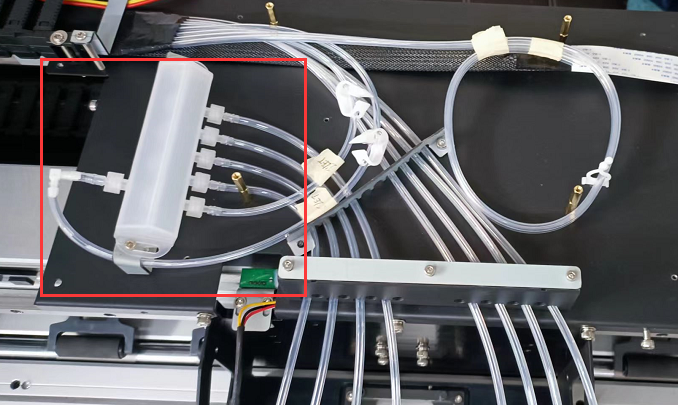
When a DTF machinery system has been running normally and suddenly exhibits an absent white underbase, or if a newly installed equipment fails to prime, the structural ink delivery path must be evaluated systematically from the tank to the nozzle plate.
⚠️ Critical Hardware Note: White DTF ink contains titanium dioxide ($TiO_2$), which is significantly heavier than CMYK organic dyes. Without continuous movement, these heavy pigments settle at the lowest physical points, solidifying inside the fine tubes, dampers, and nozzle chambers.
Check Ink Volumes & Tank Stirring: Ensure the primary white ink reservoir is filled to at least $\frac{2}{3}$ capacity. Verify that the automated magnetic white ink stirring system and timed circulation pump are fully operational.
Inspect the Physical Fluid Lines: Examine the ink delivery lines and tubes from the back tank to the carriage. Look for sharp bends, kinks, structural pinholes, or visible white sediment blockages.
Analyze the Damper and Air Accumulation: Turn off the machinery and access the carriage board. Inspect the white ink dampers. If a large pocket of air is present inside the transparent damper body, it creates a vacuum failure, leading to ink starvation.
Evaluate the Capping Station Vacuum Seal: Move the print carriage to the home parking station. Inspect the rubber capping top rim. If the capping station rim is warped, dirty, or misaligned with the printhead face, the software-driven suction pump cannot generate the negative pressure required to draw fresh ink.
The following industrial diagnostic matrix isolates specific white ink output failure modes alongside precise mechanical counteractions:
| Visual Symptom on Film | Root Technical Cause | Required Corrective Action | Maintenance Interval |
| Nozzle test sheet is completely blank in white channels | Complete printhead cable disconnection or reverse pin insertion on carriage board. | Re-seat the flat printhead flexible ribbon cable; inspect for fluid or ink burn shorts. | On initial setup / repair |
| Intermittent white lines or thin/faint opacity | Minor nozzle clogging due to early $TiO_2$ pigment sedimentation. | Initiate a standard software "Medium Cleaning" cycle; run a maximum of 2-3 times. | Daily at startup |
| White ink stops mid-print after a few inches | Dampers are starved of fluid due to internal air pockets or clogged inline filters. | Use a syringe to manually draw 3-5 mL of air/ink out through the bottom of the damper. | Every 3 months (Filter swap) |
| Software ink suction draws zero fluid to waste line | Poor alignment or structural gap between printhead nozzle plate and capping top. | Manually calibrate the ink stack position; replace worn capping station rubber rims. | Monthly inspection |
| Total blockage after extended machine storage | Dried ink accumulation inside the internal micro-nozzle channels. | Apply the nozzle soaking method: submerge the nozzle face in specialized flush for 1-2 hours. | After 5+ days of idle downtime |
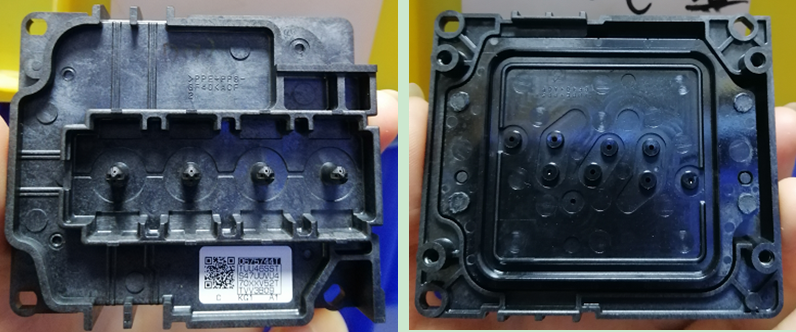
Injecting liquids forcefully into an industrial printhead (such as the Epson i3200-A1 or F1080) with a syringe creates high hydraulic pressure inside the internal micro-channels. This force regularly ruptures the delicate internal ink channel membranes or pushes fluid onto the electronic carriage circuit board, causing immediate motherboard short-circuits. Always utilize gentle negative pressure suction from the waste tube line instead.
No. Standard isopropyl alcohol reacts aggressively with the specialized binders found in textile DTF ink formulas. Exposure to alcohol causes the solvent vehicles to evaporate instantaneously, converting the remaining pigment into a sticky, dense gel that permanently locks the printhead nozzles. Only use manufacturer-approved, water-based chemical cleaning solutions designed specifically for DTF chemistry.
In standard commercial production environments, white ink filters and dampers must be treated as consumable parts and replaced every 3 months. Even with perfect circulation systems, a microscopic layer of sediment builds up on the internal fine mesh of the damper over time, creating fluid resistance that eventually starves the printhead channels during high-speed roll-to-roll jobs.
 WhatsApp me


